The Legend of Le Rocher Panet


The south shore of the St. Lawrence River around Montmagny and l’Islet is in places lacking in topographical variety. There are no cliffs nor steep slopes, but rather grassy beaches burgeoning with wild rice and sedges, murky from the fine clay of the tides. Towards the  north are vast horizons, along which the Laurentians are visible when the weather is clear. In the morning, the fog hides them away and drowns them in the ephemeral cottony mist that rises from the waters, and after nightfall, one may discern them by the illusory beacons that the fires are always lighting here and there upon their granite slopes.

L’Islet is an old village, a “bourg” as they say over there, slumbering peaceably by the tranquil waves, guarded since time immemorial by its rocky island, “l’Islette,” which is generally deserted. At most, a schooner may sometimes happen to moor there. A few barrels are unloaded, a few planks of wood carried aboard, and that’s the end of it.

The inhabitants of l’Islet, a population of old-timers, have many legends, and none is better substantiated than that of the Rocher Panet (“Panet’s rock”). This rock forms a pair with “l’Islette,” and is the visible outcropping of a little mountain submerged under the mud, surrounded by the tides, and which almost disappears at high water. It is really next to nothing, but this next to nothing has its own legend, which is perhaps only a tall tale. Everybody there knows it off by heart (or almost). It was written down in a little booklet by J. T. Jemmat, who relates it with great enthusiasm. Listen:

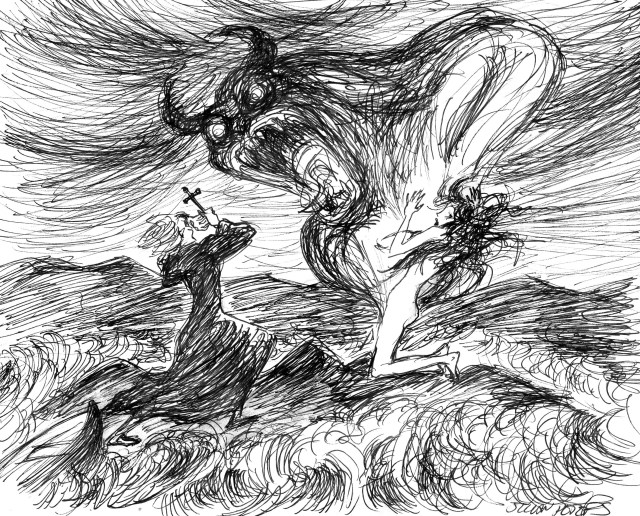
“A wretched woman, whose name and shame the legend has suppressed, had dared to sell her immortal soul and her eternal felicity to the devil, in exchange for dishonorable passions. The impure spirit appeared unsatisfied by this bargain, and wished to also possess the body of his unfortunate victim. Abusing of his power, his infernal malice cast her upon the rock, which had not the gloomy appearance that it has today: One would have thought it was an emerald floating upon the waves, resplendent in the greenness of its shrubbery and the brilliant hues of its flowers. No sooner had that cursed foot made contact with the island, however, that the petals folded inwards and wilted away, the shrubbery shriveled up and died. Continue reading

Posted in drawings, illustration, nouvelle france, quebec | Tagged , , , , , , , , , , , , , | Leave a comment

Two Montreal Views in the Style of Ukiyo-e Prints

Two scenes from near where I live – an alley in Côte-Saint-Paul and a view along the aqueduct in Verdun – rendered in a style that tries to imitate that of the nineteenth-century Japanese ukiyo-e prints by such artists as Hokusai and Hiroshige.

I think one of the reasons I always find myself so captivated by those classic prints is that they remind me, in an odd, refracted way, of the environments that I grew up in in Montreal. The simple, often straight lines, bright primary colours, low lying buildings, and striking superimpositions of green and urban spaces are characteristic of both.

Posted in illustration, montreal, painting, watercolour | Tagged , , , , , , , , , | Leave a comment

Video of “When You Are Old” by William Butler Yeats

A beautiful anime-adjacent video interpretation by James Avis of my comics adaptation of William Butler Yeats’s poem “When You Are Old.” The drawings are a homage to the Japanese shojo manga tradition, and particularly to the work of the CLAMP collective. The digital screen tones effects are by the brilliant Maryse Daniel.

The original comics adaptation, along with 23 others, can be found in my new book, Poems to See By: A Comic Artist Interprets Great Poetry (Plough Publishing): https://www.plough.com/en/topics/culture/poetry/poems-to-see-by  

Posted in comics, Poetry, Poetry Comics, William Butler Yeats | Tagged , , , , , , , , , , , , , | 6 Comments

Video of “may my heart always be open to little” by e e cummings

A delightful interpretation by Jim Avis of one my poetry comics, this time my adaptation of “may my hear always be open to little” by e e cummings.

The original comics adaptation, along with 23 others, can be found in my new book, Poems to See By: A Comic Artist Interprets Great Poetry (Plough Publishing): https://www.plough.com/en/topics/culture/poetry/poems-to-see-by  

Posted in comic book poetry, comics, humour, illustration, Poetry, Poetry Comics, watercolour | Tagged , , , , , | 2 Comments

Video of “Invictus” by William Ernest Henley

A new video interpretation by Jim Davis of my comics adaptation of William Ernest  Henley’s classic poem “Invictus” (1875). Avis has added a surprise flourish to the final drawing, one that I feel is in keeping with Henley’s theme of thumbing one’s nose at the tyranny of fate, if not perhaps with Victorian propriety.

This comics adaptation, along with 23 others, can be found in my new book, Poems to See By: A Comic Artist Interprets Great Poetry (Plough Publishing): https://www.plough.com/en/topics/culture/poetry/poems-to-see-by  

Posted in comics, humour, illustration, Poetry, Poetry Comics | Tagged , , , , , , | 2 Comments

Video of “Somewhere or Other” by Christina Rossetti

A very sensitive video adaptation by Jim Avis of my comics interpretation of Christina Rossetti’s poem “Somewhere or Other.” I find this one makes particularly effective use of Avis’s signature zooming technique. The terrific reading is by “the Wordman” and the musical accompaniment is a piece by Charles Ives.

This comics adaptation, along with 23 others, can be found in my new book, Poems to See By: A Comic Artist Interprets Great Poetry (Plough Publishing): https://www.plough.com/en/topics/culture/poetry/poems-to-see-by  

Posted in comics, illustration, Poetry, Poetry Comics, watercolour | Tagged , , , , , , , , , , | 2 Comments

Video of “Those Winter Sundays” by Robert Hayden

Another video interpretation by Jim Avis of my comics interpretation of the poem “Those winter Sundays” by the American poet Robert Hayden (who by the way studied under W. H. Auden, who was featured in the last Jim Avis video here). The images are accompanied by a wonderful reading of the text by the poet himself.

This comics adaptation, along with 23 others, can be found in my new book, Poems to See By: A Comic Artist Interprets Great Poetry (Plough Publishing): https://www.plough.com/en/topics/culture/poetry/poems-to-see-by  

Posted in comic book poetry, comics, illustration, Poetry, Poetry Comics, watercolour | Tagged , , , , , , | Leave a comment

“La Belle Dame Sans Merci – A Tone Poem” by Fletcher Cunniff

A very cool and haunting musical composition by Fletcher Cunniff, inspired by John Keats’s 1819 poem, “la Belle Dame Sans Merci.” The track integrates an old vinyl recording of an exquisitely quavering, Mid-Atlantic-accented reading by the American character actor Theo Marcuse (1920-1967) and is accompanied in this video (also by Cunniff) with illustrations from my comics interpretation of the poem.

Posted in comics, illustration, John Keats, Poetry, Poetry Comics | Tagged , , , , , , | 3 Comments

Video of “Musée des Beaux Arts” by W. H. Auden

Another great video interpretation by Jim Avis, this time of my comics adaptation of W. H. Auden’s “Musée des Beaux Arts.” The reading is by the poet himself. Auden’s oft-anthologized poem is thought to obliquely criticize the Western powers’ ignoring of Hitler’s expansion into Czechoslovakia in 1938, and the comic and the animation include references to other instances when Western public opinion largely turned its back on foreign tragedies that its government’s had largely contributed to provoking: The “death flights” employed by the Argentinian military dictatorship of 1976-1983 and the sinking of refugee ships in the Mediterranean in recent years.

This comics adaptation, along with 23 others, can be found in my new book, Poems to See By: A Comic Artist Interprets Great Poetry (Plough Publishing): https://www.plough.com/en/topics/culture/poetry/poems-to-see-by  

Posted in comic book poetry, comics, illustration, painting, Poetry, Poetry Comics | Tagged , , , , , , , , | Leave a comment

“La città radiosa” (“The Radiant City”) by Vincenzo Mascolo

My adaptation of comics of a poem by the Italian poet Vincenzo Mascolo. The poem represents a section of a long poetic cycle (still in progress) titled “Orphée,” which is in turn inspired  by the modern classical album of the same name by the Icelandic composer Jóhann Jóhannsson. Besides the classical myth of Orpheus, the passage I illustrated alludes to T. S. Eliot’s “The Love Song of J. Alfred Prufrock,” the “Ville radieuse” project of Le Corbusier, the three Italian Renaissance paintings of “The Ideal City,” Italo Calvino’s Invisible Cities, and Dante’s Inferno (and possibly others that I didn’t pick up on!). All in a few short lines. (Scroll down to the end for an English translation)

THE RADIANT CITY

Often
we would go
through the streets
soaked
in the sewage
of the night
to seek
in the
construction site
over the border
the remains
of the ideal city
Le Corbusier’s
sketches
the detritus
of the common good
liberty
democracy
Marco Polo’s
journey
to reach
Tecla
its
starry
night’s project
that the darkness
of the underworld
conceals from you

(Based on a translation-in-progress by John Morre and Giorgia Sensi)

Posted in "The Love Song of J. Alfred Prufrock" by T.S. Eliot, bande dessinée, comics, Imaginary City, Poetry, Poetry Comics | Tagged , , , , , , , , , , , , , , , , | Leave a comment