Views of an Imaginary City 6: Dastazuriki in the Little Switzerland Neighbourhood

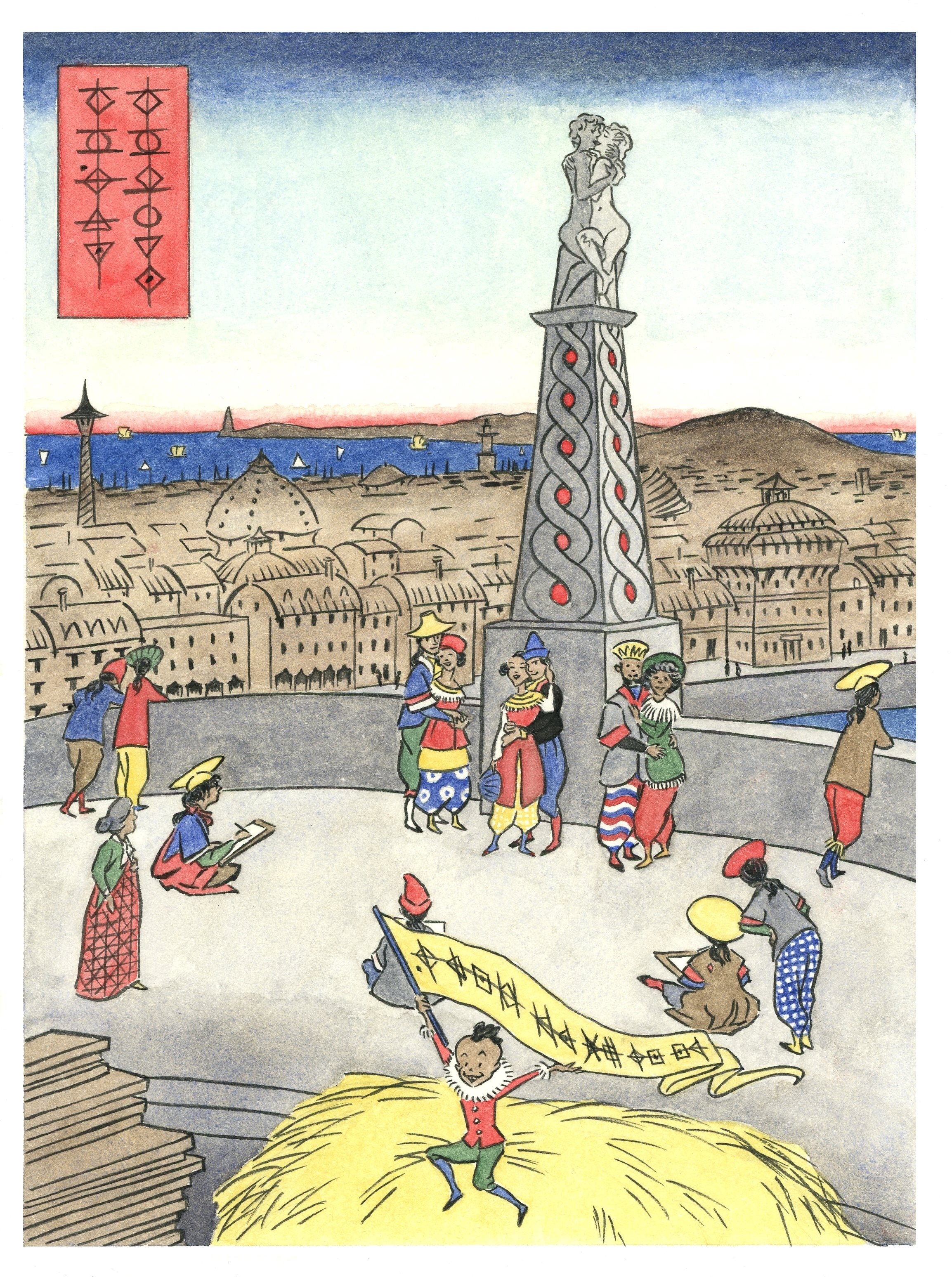
Western traders first arrived in Sensuka soon after the city’s founding by the emperor Bulodi I as his new imperial capital. Two decades later, however, following a moral panic over the corrupting influence of Western values, religious beliefs, and food, the empress Nanèh issued an edict prohibiting all commerce with foreign nations. Nevertheless, another two decades after that, in the reign of Bulodi II, an amendment was made to this ban so as to exempt merchants from Switzerland. The young monarch held a personal soft spot for the Swiss for a curious reason: his extreme fondness for cuckoo clocks. This passion eventually led to the construction of the Great Imperial Cuckoo Clock over one of the gates of the Imperial Palace, thought to be the largest such clock ever built (See n. 27). As numerous Swiss clockmakers and clockmaking materials had in any case to be brought over to Sensuka for the purpose of completing this project, the emperor was persuaded to allow Swiss sailors to bring other goods as well. This policy has persisted, with the Swiss remaining as the sole go-between importers of all overseas products to the empire. The result is that there is now a fairly large community of Swiss residents in Sensuka. the great majority of them live in the neighbourhood known as “Little Switzerland” on the eastern side of Sensuka Harbour, facing Orepi. Continue reading

Posted in Imaginary City, watercolour | Tagged , , , , , , , , , , , , | Leave a comment

Christmas on Rue Champigny

This watercolour was commissioned by the Montreal financial services firm ASSURART Inc. for their 2020 company holiday card. It was very much inspired by the magical winter scenes by the Japanese printmaking artist Hasui Kawase (1883-1957). Although the image is based on photographs that I took on rue Champigny in the neighbourhood of Côte-Saint-Paul near where I live, I had to add quite a bit of snow, as we’ve had so little of it so far this year.

Posted in illustration, montreal, watercolour | Tagged , , , , , , , , , , , , , | 4 Comments

Video of “The force that through the green fuse drives the flower” by Dylan Thomas

A video interpretation by Jim Avis of my comics adaptation of one of Dylan Thomas’s first poems. Featuring a stirring reading by the poet himself.

The original comics adaptation, along with 23 others, can be found in my new book, Poems to See By: A Comic Artist Interprets Great Poetry (Plough Publishing, 2020).

Posted in "The Love Song of J. Alfred Prufrock" by T.S. Eliot, comics, illustration, Poetry, Poetry Comics, watercolour | 2 Comments

Video of “The World Is Too Much With Us” by William Wordsworth

A very amusing video by Jim Avis, based on my comics adaptation of William Wordsworth’s c. 1802 sonnet, “The World Is Too Much With Us.” The reading is by Tom Hiddleston. 2020, a year in which, for many, the world was not with us enough, marks the 250th anniversary of Wordsworth’s birth. It is also the year in which I finally caved and got myself a smartphone.

The original comics adaptation, along with 23 others, can be found in my new book, Poems to See By: A Comic Artist Interprets Great Poetry (Plough Publishing).


Posted in comics, illustration, Poetry, Poetry Comics | Tagged , , , , , , , , , | Leave a comment

Views of an Imaginary City 2: The Teposensuki or “Lovers’ Bridge”


The Teposensuki (“Sensuka Bridge”) is the widest and most monumental of the bridges spanning the Juminta River in the central area of the city known as the Kadini (“Nest”). It is also notable for being the sole bridge in the capital built on two levels: a wide central carriageway for commercial traffic and two narrower raised pedestrian passageways on either side. The latter allow citizens and tourists to traverse the bridge at a more leisurely pace and take in the impressive views over the riverfront.

Mounted at the very centre of the bridge’s south balustrade is a stone statue of a man and woman embracing, known simply as “The Lovers.” Such is the fame of this statue that the Teposensuki is often referred to as the Teponemoi (“Lovers’ Bridge”), and indeed that is the name by which it is most commonly known outside of Sensuka. The statue was created over a hundred years ago, in the reign of the Empress Aritokéh, by the celebrated sculptor Pumanton. According to legend, “The Lovers“ was originally two separate sculptures, commissioned for the garden of a nobleman’s villa. Continue reading

Posted in Imaginary City, watercolour, writing | Tagged , , , , , , | Leave a comment

Video of “The Love Song of J. Alfred Prufrock” read by Joseph Miller

The American actor Joseph Miller has put created this short video featuring his  dramatic reading of T. S. Eliot’s “The Love Song of J. Alfred Prufrock” combined with my comics illustrations of the same poem.

Posted in "The Love Song of J. Alfred Prufrock" by T.S. Eliot, comics, illustration, Poetry, Poetry Comics | Tagged , , , , , , | Leave a comment

Views of an Imaginary City 1: Entering Sensuka Bay

  1. Entering Sensuka Bay

In this opening print of the series, the viewer is transported onto the deck of one of the steam-powered ferries linking Sensuka to Kadonde, on the other side of the Golden Strait. The steamer is rounding the cape of Sakalumi Island at the entrance of Sensuka Bay. The lower portion of the island’s celebrated seashell-shaped lighthouse is just visible on the left side of the image.

This is the moment, for all sea vessels approaching Sensuka from the west, in which the city’s spectacular natural harbour first comes into view. Spread out before us at the far end of the bay is the densely built-up peninsula of Orepi, which juts out into the harbour by the mouth of the Juminta River. Orepi’s famous spiral tower rises from the warehouses and the forest of masts lining the area’s bustling harbourfront. Lomuku Castle—the city’s most iconic building, along with the Orepi Tower and the Sakalumi Lighthouse—dominates the city centre from its perch atop Labetachi Hill. Directly ahead of the ferryboat, another steamer ferry is moving in the opposite direction, away from the port. The placement of the column of smoke rising from its chimneystack makes the Lomuku appear to be floating in the air. This is a no doubt intended as a nod to the castle’s name, which means “cloud.” Continue reading

Posted in illustration, watercolour | Tagged , , , , | 2 Comments

Video of “Spring and Fall” by Gerard Manley Hopkins

A beautiful and moving video by Jim Avis, pairing my comics adaptation of Gerard Manley Hopkins’s poem “Spring and Fall” with a musical interpretation of that same poem by Natalie Merchant.

The original comics adaptation, along with 23 others, can be found in my new book, Poems to See By: A Comic Artist Interprets Great Poetry (Plough Publishing).

Posted in comics, illustration, Poetry, Poetry Comics, watercolour | Tagged , , , , , , , , , | Leave a comment

Video of “Conscientious Objector” by Edna St. Vincent Millay

With Halloween around the corner, here is a suitably eerie video adaptation by Jim Avis of my own comics interpretation of Edna St. Vincent Millay’s poem “Conscientious Objector” (1934). The poem is read by Natalie Rushing.

The original comics adaptation, along with 23 others, can be found in my new book, Poems to See By: A Comic Artist Interprets Great Poetry (Plough Publishing).

Posted in comics, illustration, Poetry, Poetry Comics | Tagged , , , , , , | 2 Comments

“Not Waving But Drowning” by Stevie Smith in Plough Quarterly

My comics adaptation of one of my all-time favourite poems, Stevie Smith’s “Not Waving But Drowning”(1957) appears today on the Plough.com website. The comic was created last year for inclusion in “Poems to See By,” (published by Plough Publishing in March of this year) but ultimately didn’t make the final cut.


Posted in comics, illustration, Poetry, Poetry Comics | Tagged , , , , | Leave a comment