A selection of my comics, poetry comics, and other illustration work – All images copyright Julian Peters – contact: info@jpeterscomics.com – Follow me on instagram @julianpeterscomics
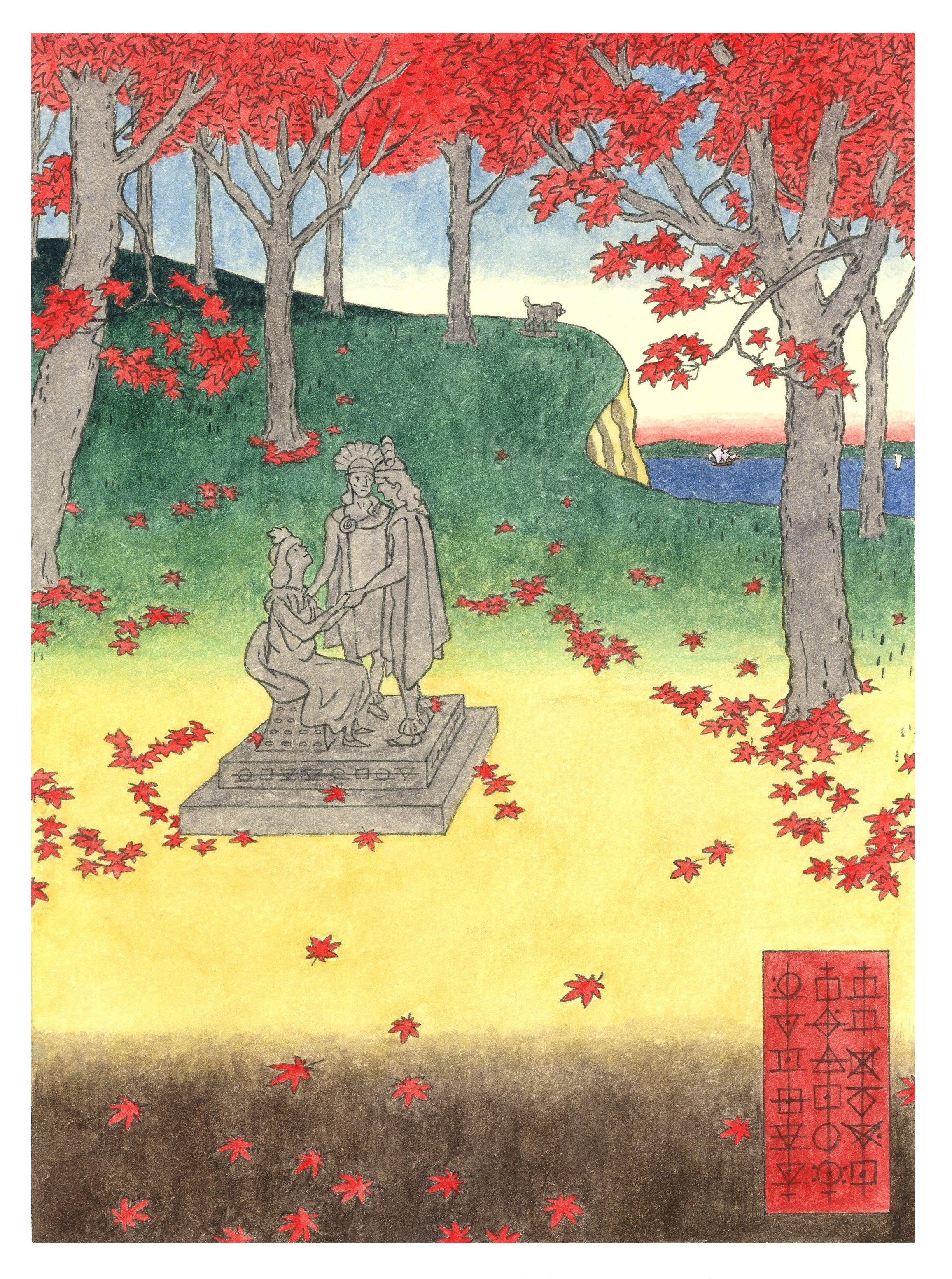
The city of Okrona was the imperial capital, on and off, for more than eleven centuries (and is still sometimes regarded as the Empire’s cultural capital). On the occasion of the 150th anniversary of the transfer of the imperial seat to Sensuka, the municipal government of Okrona decided to gift the citizens of the present capital with a monumental sculpture celebrating the enduring friendship between their two cities.
The sculpture was created by the famous sculptor Dinorfi (a native-born Okronan) and depicts three allegorical figures: two standing male figures representing the cities of Okrona and Sensuka, and a seated female figure representing the Empire. The older male, who represents Okrona, has his left arm over the younger male’s (Sensuka’s) shoulder in a gesture of encouragement as the latter gathers the woman’s hands in his own. The represented meaning, then, would seem to be that of Okrona giving its blessing to the Empire’s transfer of its capital to Sensuka.
It is noteworthy, however, that the Okrona figure’s right hand is resting on the Empire figure’s shoulder. Indeed, on a close inspection he appears to be pressing into it in an almost sensual manner. Because of this, the sculpture was widely interpreted at the time as an allusion to a traditional (now rare) conjugal arrangement known as tramago. In such relationships, a woman (or man) has one live-in partner and another official partner who lives in another household, usually with another partner (who in turn has another partner living somewhere else, and so on). According to this interpretation, then, while the Empire would now be “moving in” with Sensuka, she would continue to be Okrona’s lover as well.
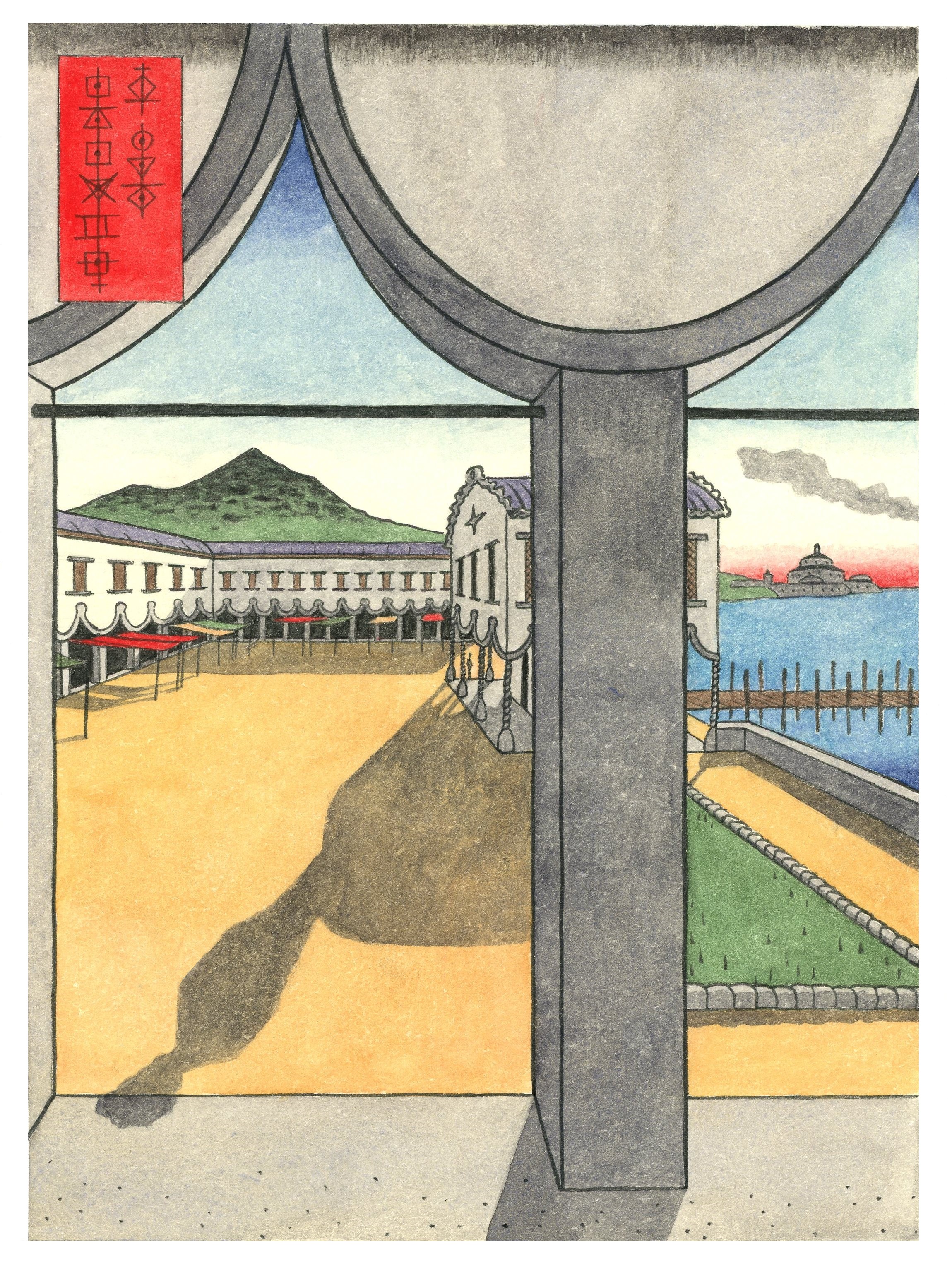
Kadukaripaza (Karipaza Square) in the Korkidèh neighbourhood is one of the most appealing spots in all the imperial capital. The square is lined on three sides with two-storey whitewashed buildings, all of which have a row of arcades running along the ground floor. Underneath these arcades are several inexpensive restaurants known as nopichi, which specialize in various forms of kovenesiko, dishes of raw fish in fermented fish sauce. Kovenesiko, a name which means “old and new,” are usually enjoyed with a glass of resinated white wine, with which the nopichi are abundantly stocked. The fourth side of the square gives out directly onto the waters of Rejoma Bay. This has led to the Karipaza being described as Sensuka’s “dining room on the sea.”
At the centre of the square is the Najiri (Empress) Embarcadero. It is so named because it was built at the behest of the empress Ofisi, the consort of Bulodi II. The structure’s somewhat frilly decorations stand in contrast with the minimalism of the surrounding buildings. It is nonetheless architecturally well-integrated with the rest of square, being also whitewashed and arcaded. From here one can take a ferry to the Island of Rateliska, with its famous pleasure gardens (See n. 22). To the right we see the trail of smoke from the ferryboat, which has just moved off the edge of the picture plane in the direction of the island.
Kadukaripaza is a favourite destination for both tourists and Sensukans. In this view, however, the artist has curiously decided to depict the square almost completely devoid of people. The long, deep shadows indicate a sunny late afternoon, and yet the tables and chairs of the outdoor terraces of the nopichi have all been taken inside, and all the window shutters are closed. Standing under the arcades of the embarcadero is the scene’s only human presence: a tiny silhouetted figure, who is nonetheless casting an enormous shadow all the way across the square, almost to the point where the viewer of the print would be standing. There is an overwhelming feeling that this person is waiting for one, that this is somehow the hour of reckoning that one has long put off. And yet, there is no fear.
In the top left-hand corner of the print we can see the massive Rozusu sea fortress at the end of Korkidèh Point. It is possible that the artist’s decision to depict a deserted square is a play on the fortress’s name, which means “silence.”
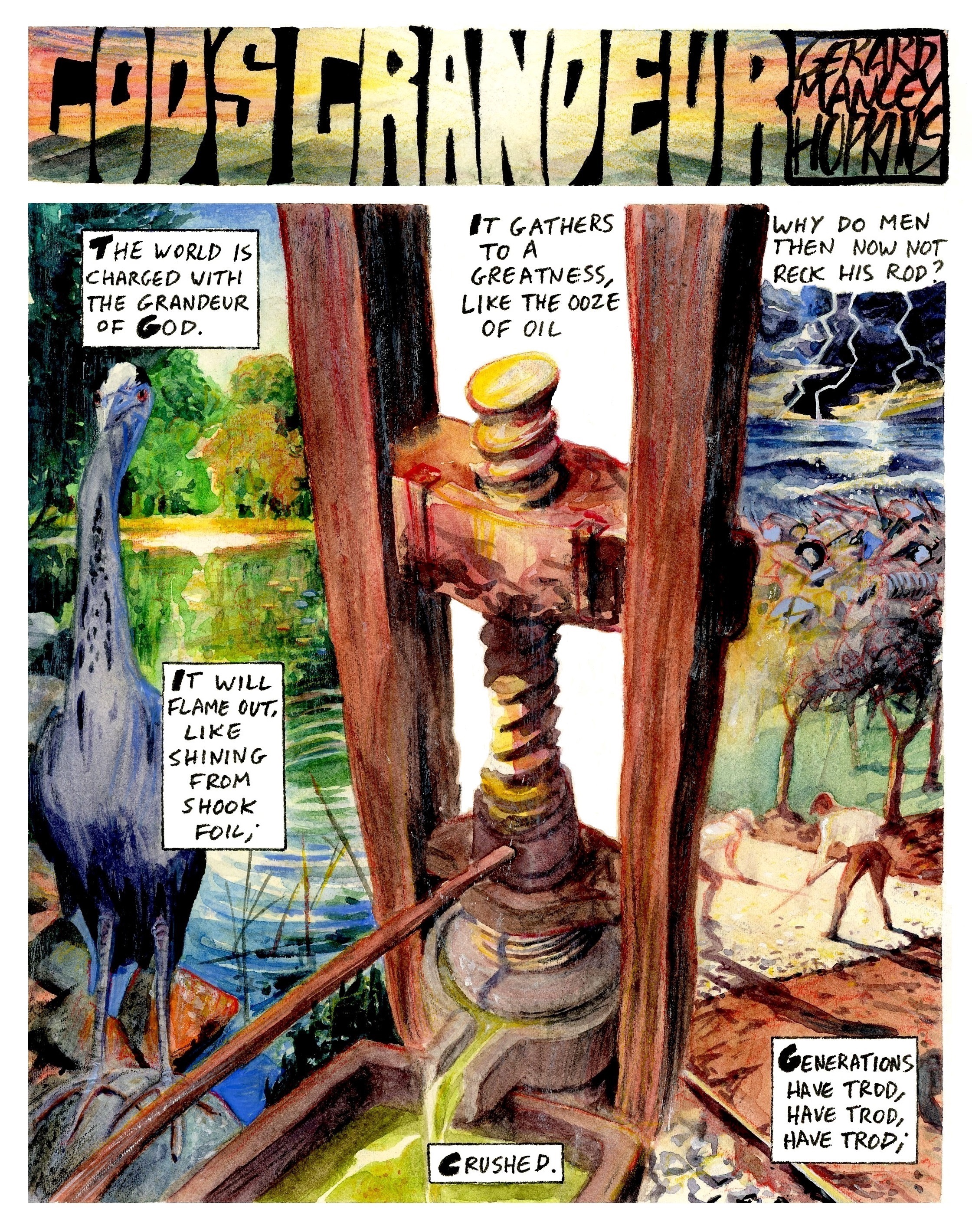
July 28 marks the 179th anniversary of the birth of Gerard Manley Hopkins, the celebrated English Jesuit priest who is considered one of the most influential poets of the 19th century.
To celebrate Hopkins’s birthday, the Jesuit Conference of Canada and the United States commissioned me to create a comics adaptation of one of his most famous sonnets, “God’s Grandeur.”
If you would like to get a free copy of the full four-page comics adaptation, you can do so by signing up to the Jesuits’ website via this link: https://www.jesuits.org/hopkins/
Jim Avis’s sensitive video interpretation of my admittedly quite bizarre imagining of an alternative funeral rite (though one inspired by traditional practices in East Africa). The pohutukawa is a real tree, btw, native to New Zealand. It’s bright red flowers blossom in December, and for this reason it is also known as a New Zealand Christmas tree.
We are looking southeast over Sensuka Bay from the great stone wharf at Orepi. It is very early morning, and the first sun’s rays have just caught the facades of the eastward-facing buildings on the right side of the print. Although much of the port is still shrouded in shadows, it is already bustling with activity. Dock workers are rolling heavy barrels towards a sailboat and unloading huge bales of spices from a ship, merchants are negotiating prices, sailors are caulking a hull, a fisherman is repairing a net, and a loan shark is giving instructions to his collector from inside a covered sedan chair. Sidling along the wall of a grog tavern on the left side of the image, a prostitute is making her way back home.
The artist’s wonderment at the beauty of the scene is quite evident. Contrary to most of the other prints in the series, the effects of light and shadow have been recorded in great detail. Several early morning visits to the location must have been necessary in order for the artist to accurately set down all of the nuances of this ephemeral moment just after the sun has crested the horizon.
It seems likely that this image, as with the view of the Lovers’ Bridge (See n. 2), contains a self-portrait of the artist. This would be the figure in the right-hand corner seated next to what appear to be some charcoals and a sheaf of paper. The man has cast his drawing instruments aside, and holds his arms outstretched before him. His fingers are extended in a grasping gesture, almost as though he were trying to grab hold of all the morning’s magnificence spread out before him.
This pose may be intended to be read as an expression of the artist’s frustration at the elusive nature of beauty. Such an elusiveness is indeed a central concept of Sensukan aesthetics. According to many of the most influential Sensukan aestheticians, there is always in our appreciation of a beauty a concomitant desire to possess it somehow. Faced with a beautiful thing, we wish to bring it into ourselves, or to become a part of it, in a way that, we sooner or later realize, is ultimately impossible. Even if we concentrate all of our admiration and attention on one small part of it, it is as though the essence of that beauty will then automatically be displaced elsewhere, into another part, or into a memory that it conjures up, or the memory of a memory.
More than most people, artists may delude themselves for a moment into believing they have caught hold of that beauty, setting it down forever in ink or paint. Even in these rare instances, the Sensukan aestheticians would point out, the victory will nevertheless prove a hollow one. If the artists have succeeded at all, it will be only in the rather pitiful objective of signalling to their fellow humans that they too have experienced that aching, nameless longing in the face of beauty, that all this loveliness was not lost on them (even as everything, everything is lost on them, and on all of us). As for that which they have actually created (in this best-case scenario), it will be just another beautiful thing from which they are separate. They will remain, as before, outside observers of beauty, rather than living participants in it.
If the fleeting majesty of this harbour morning can belong to anyone, it is perhaps only to the longshoremen, the stevedores, the shipwrights and seamen, their dark silhouettes and bent-over backs gilded by the morning sun, wholly at one with all that beauty in the moment in which they are too occupied with the task at hand to pay it any notice.
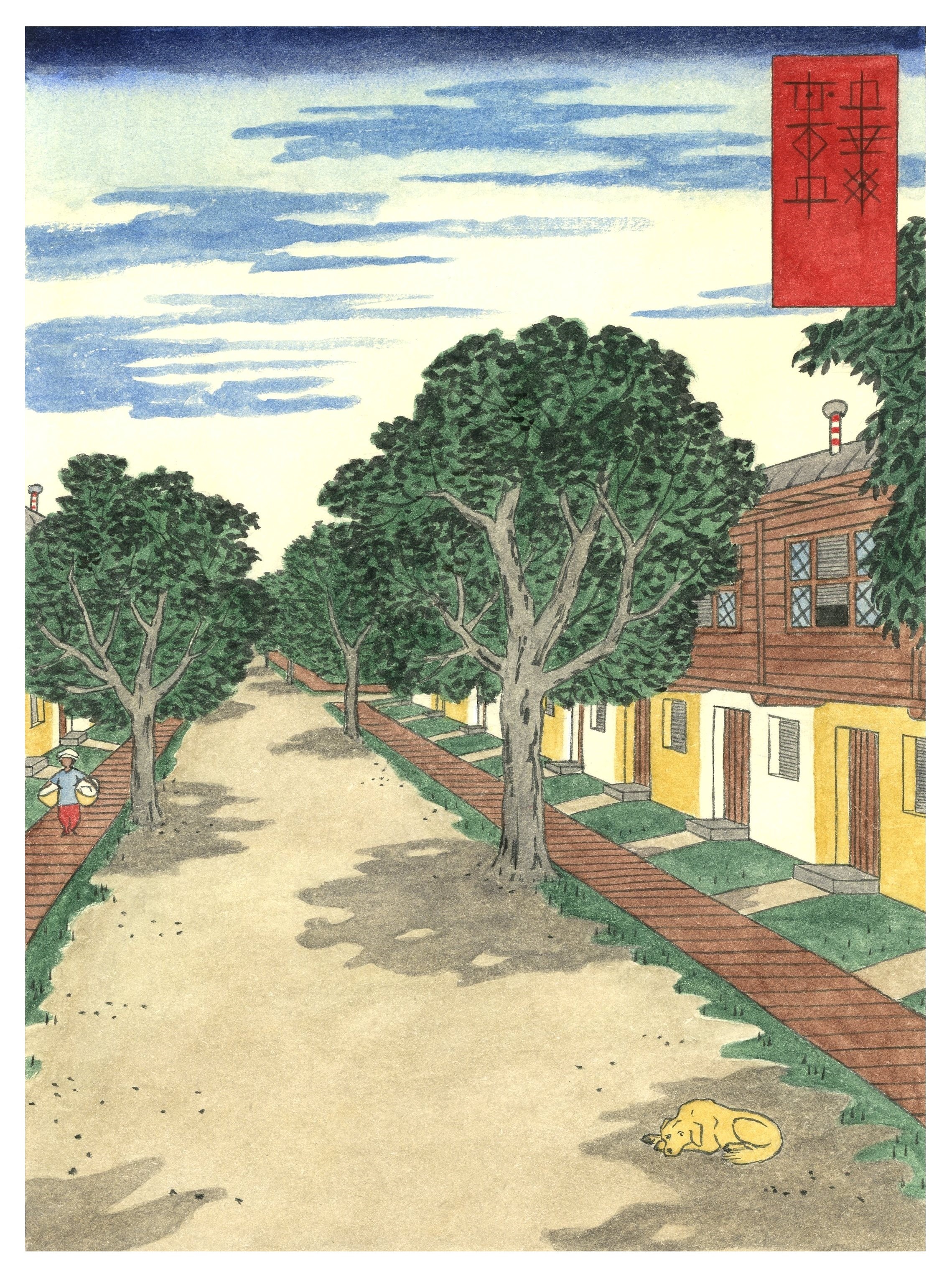
The outer district of Najirèh (“Empress”) is so named in honour of the empress Aritokèh, during whose reign the area’s first streets were laid out. It is located on a raised plateau surrounded by rice fields to the north, south, and east, and by the Golu Canal (See n. 38) to the west. The unnamed avenue presented here is typical of streets in this part of the city, with their tall, regularly spaced trees and narrow wooden sidewalks. Typical, too, are the long rows of attached houses, with a ground level built of stuccoed masonry and an overhanging second story of wood. There is nothing particularly remarkable about the depicted scene, and it may at first be difficult to understand why the artist chose to include it in the series.
Upon reflection, however, one may well conclude that it is exactly in such generic spots that the true spirit of the city is to be found. Any tourists visiting Sensuka for the weekend can marvel at the monumental buildings in the city centre, stroll through the pleasure gardens of Rateliska, sample the street foods along the Terenfi Canal, or dance the night away in the Kadukilo during the Totamontra festival. If they know the right locals, they may also be shown the way to smoky, semilegal poetry dens, or to hole-in-the wall portside restaurants where the fishermen come to eat their own catch, and hand it over still flopping to the kitchen staff. But it is not these sights and experiences, however captivating or memorable, that make Sensuka Sensuka. What is really special about the city—what is truly worth marvelling at—are the vast number of nondescript neighbourhoods like the one depicted in this print, these rows upon rows of lives—of many generations of lives, which we will never know and we can never know. And all these lives, one way or another, revolve, or once revolved, around the same centrifugal force: Sensuka—not the physical city, but an energy, or an idea, or whatever dream it is that the city represents in the heart and mind of each individual.
Two people walk past each other on a quiet street corner, both looking about their surroundings in an apparent state of reverie. The inscription tells us that we are looking at a nizimoamuàri, which could be translated as “a past or future love place.” (This is a somewhat awkward translation. The word muàrirefers to any time—past, future, or hypothetical—that is not the present moment.) Nizimoamuàri are particular locations that, every time one happens to set foot in them, convey the impression that they bear some kind of not-quite-definable connection to one’s romantic life. This curious sensation is usually described as being somewhat like a memory, and yet a memory that does not seem to correspond to any actual incident in one’s life that one can identify. At the same time, it can register a little like a premonition, a feeling that one is meant to experience something important here with someone someday, that this place is connected in some way to that great mythical love story that one never quite stops imagining for oneself.
People generally have several such nizimoamuàri. They tend to be located in places one has frequented all one’s life, or at least to bear some resemblance to other places one used to frequent. It should be emphasized, however, that the peculiar influence of these places is an extremely vague and subtle one. In many cases, people are only subconsciously aware of it. Contributing to this lack of awareness is the fact that nizimoamuàri are for the most part rather nondescript spots: a particular bench in a park, perhaps, or the landing of a staircase in a multileveled shopping bazaar, or a street corner near one’s work.
The explanations put forward for the nizimoamuàri phenomenon are numerous: One theory is that one happened to witness an especially attractive stranger pass by here once, or a couple kissing with a particular intensity—or perhaps just talking and laughing, with an ease and a complicity that one has so often dreamed of for one’s own relationships. Though these specific memories, being of little concrete import to one’s life, have long since vanished into oblivion, the location’s romantic associations have remained. Or perhaps it is something in how the light falls over this particular arrangement of buildings or trees in this particular orientation, or how the faded words of an ancient pipe tobacco advertisement always conjure up for one the refrain of an old song, or the way the perfume emanating from the corner flower shop always hits one just at the moment one is walking away from it—something, anyway, in a physical property of this location that seems to transport one back to another place and another time, neither of which one can quite pinpoint, wherein one experienced something romantic, or at least dreamt of it with a special ardour.
This watercolour was commissioned by the Montreal financial services firm ASSURART Inc. for their 2022 company holiday card. Like the card I did from them in 2020, it depicts a scene observed on Rue Champigny, in the Côte-Saint-Paul neighbourhood of Montreal.



 julian peters comics