A selection of my comics, poetry comics, and other illustration work – All images copyright Julian Peters – contact: info@jpeterscomics.com – Follow me on instagram @julianpeterscomics
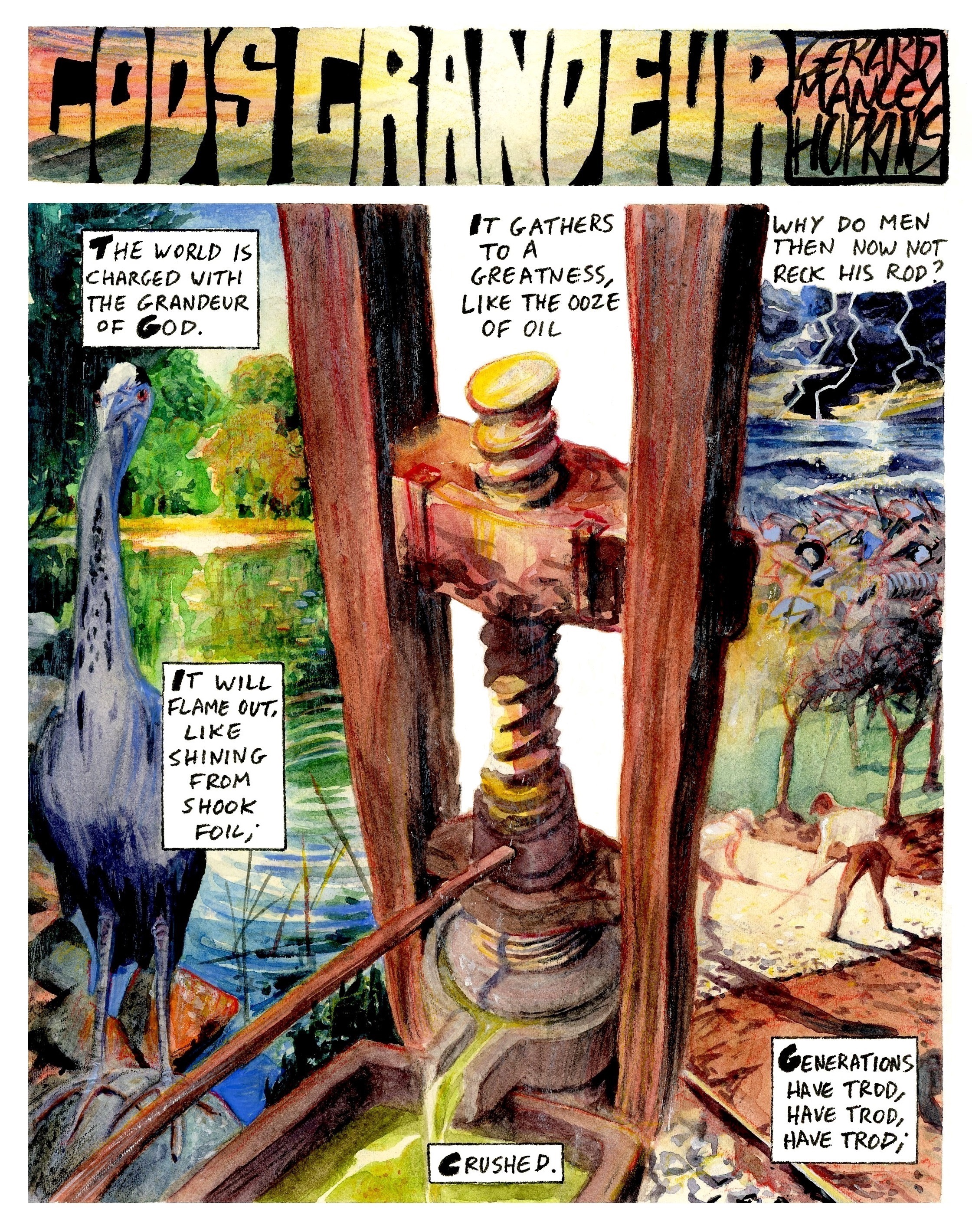
July 28 marks the 179th anniversary of the birth of Gerard Manley Hopkins, the celebrated English Jesuit priest who is considered one of the most influential poets of the 19th century.
To celebrate Hopkins’s birthday, the Jesuit Conference of Canada and the United States commissioned me to create a comics adaptation of one of his most famous sonnets, “God’s Grandeur.”
If you would like to get a free copy of the full four-page comics adaptation, you can do so by signing up to the Jesuits’ website via this link: https://www.jesuits.org/hopkins/
Jim Avis’s sensitive video interpretation of my admittedly quite bizarre imagining of an alternative funeral rite (though one inspired by traditional practices in East Africa). The pohutukawa is a real tree, btw, native to New Zealand. It’s bright red flowers blossom in December, and for this reason it is also known as a New Zealand Christmas tree.
We are looking southeast over Sensuka Bay from the great stone wharf at Orepi. It is very early morning, and the first sun’s rays have just caught the facades of the eastward-facing buildings on the right side of the print. Although much of the port is still shrouded in shadows, it is already bustling with activity. Dock workers are rolling heavy barrels towards a sailboat and unloading huge bales of spices from a ship, merchants are negotiating prices, sailors are caulking a hull, a fisherman is repairing a net, and a loan shark is giving instructions to his collector from inside a covered sedan chair. Sidling along the wall of a grog tavern on the left side of the image, a prostitute is making her way back home.
The artist’s wonderment at the beauty of the scene is quite evident. Contrary to most of the other prints in the series, the effects of light and shadow have been recorded in great detail. Several early morning visits to the location must have been necessary in order for the artist to accurately set down all of the nuances of this ephemeral moment just after the sun has crested the horizon.
It seems likely that this image, as with the view of the Lovers’ Bridge (See n. 2), contains a self-portrait of the artist. This would be the figure in the right-hand corner seated next to what appear to be some charcoals and a sheaf of paper. The man has cast his drawing instruments aside, and holds his arms outstretched before him. His fingers are extended in a grasping gesture, almost as though he were trying to grab hold of all the morning’s magnificence spread out before him.
This pose may be intended to be read as an expression of the artist’s frustration at the elusive nature of beauty. Such an elusiveness is indeed a central concept of Sensukan aesthetics. According to many of the most influential Sensukan aestheticians, there is always in our appreciation of a beauty a concomitant desire to possess it somehow. Faced with a beautiful thing, we wish to bring it into ourselves, or to become a part of it, in a way that, we sooner or later realize, is ultimately impossible. Even if we concentrate all of our admiration and attention on one small part of it, it is as though the essence of that beauty will then automatically be displaced elsewhere, into another part, or into a memory that it conjures up, or the memory of a memory.
More than most people, artists may delude themselves for a moment into believing they have caught hold of that beauty, setting it down forever in ink or paint. Even in these rare instances, the Sensukan aestheticians would point out, the victory will nevertheless prove a hollow one. If the artists have succeeded at all, it will be only in the rather pitiful objective of signalling to their fellow humans that they too have experienced that aching, nameless longing in the face of beauty, that all this loveliness was not lost on them (even as everything, everything is lost on them, and on all of us). As for that which they have actually created (in this best-case scenario), it will be just another beautiful thing from which they are separate. They will remain, as before, outside observers of beauty, rather than living participants in it.
If the fleeting majesty of this harbour morning can belong to anyone, it is perhaps only to the longshoremen, the stevedores, the shipwrights and seamen, their dark silhouettes and bent-over backs gilded by the morning sun, wholly at one with all that beauty in the moment in which they are too occupied with the task at hand to pay it any notice.
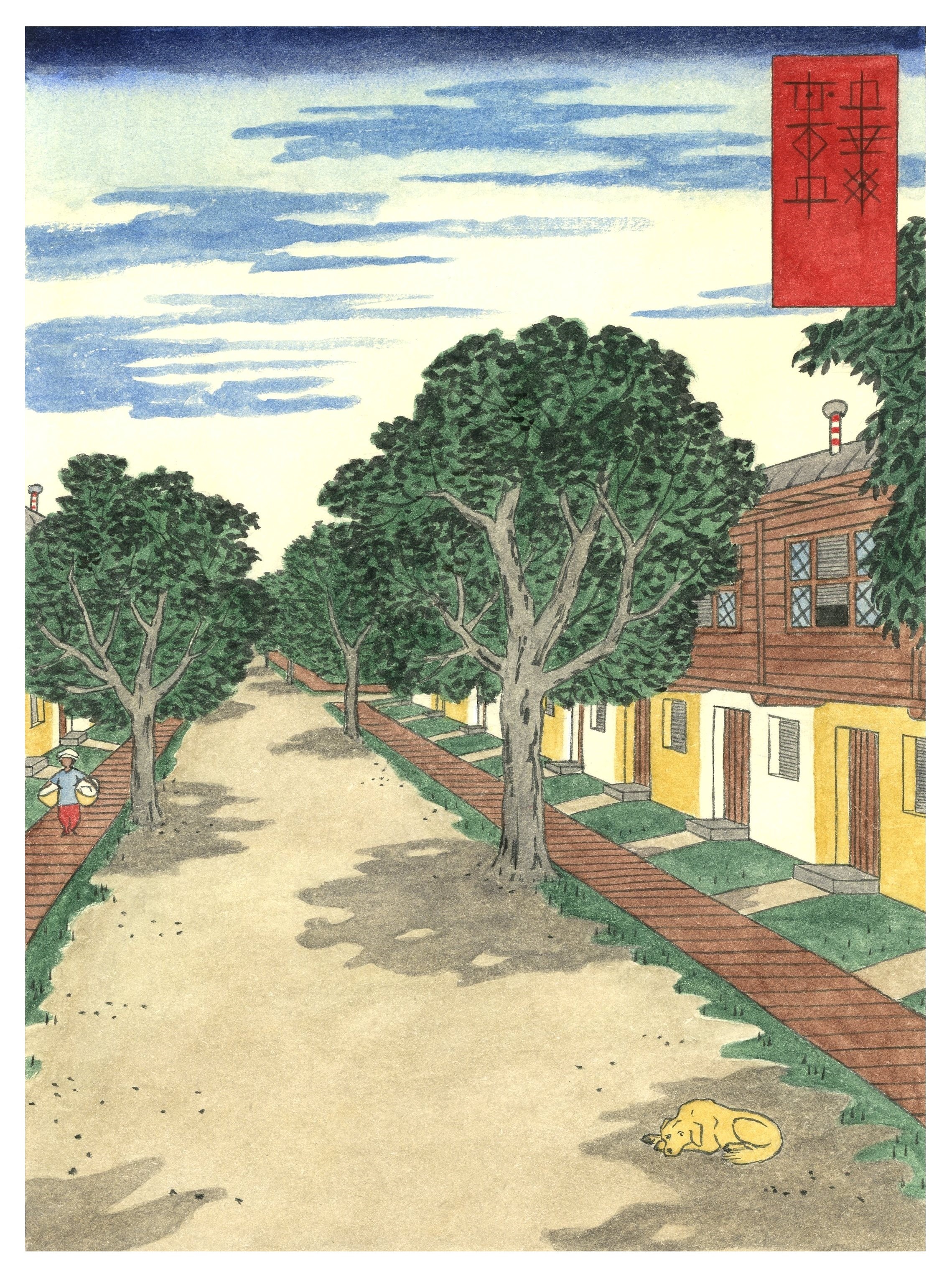
The outer district of Najirèh (“Empress”) is so named in honour of the empress Aritokèh, during whose reign the area’s first streets were laid out. It is located on a raised plateau surrounded by rice fields to the north, south, and east, and by the Golu Canal (See n. 38) to the west. The unnamed avenue presented here is typical of streets in this part of the city, with their tall, regularly spaced trees and narrow wooden sidewalks. Typical, too, are the long rows of attached houses, with a ground level built of stuccoed masonry and an overhanging second story of wood. There is nothing particularly remarkable about the depicted scene, and it may at first be difficult to understand why the artist chose to include it in the series.
Upon reflection, however, one may well conclude that it is exactly in such generic spots that the true spirit of the city is to be found. Any tourists visiting Sensuka for the weekend can marvel at the monumental buildings in the city centre, stroll through the pleasure gardens of Rateliska, sample the street foods along the Terenfi Canal, or dance the night away in the Kadukilo during the Totamontra festival. If they know the right locals, they may also be shown the way to smoky, semilegal poetry dens, or to hole-in-the wall portside restaurants where the fishermen come to eat their own catch, and hand it over still flopping to the kitchen staff. But it is not these sights and experiences, however captivating or memorable, that make Sensuka Sensuka. What is really special about the city—what is truly worth marvelling at—are the vast number of nondescript neighbourhoods like the one depicted in this print, these rows upon rows of lives—of many generations of lives, which we will never know and we can never know. And all these lives, one way or another, revolve, or once revolved, around the same centrifugal force: Sensuka—not the physical city, but an energy, or an idea, or whatever dream it is that the city represents in the heart and mind of each individual.
Two people walk past each other on a quiet street corner, both looking about their surroundings in an apparent state of reverie. The inscription tells us that we are looking at a nizimoamuàri, which could be translated as “a past or future love place.” (This is a somewhat awkward translation. The word muàrirefers to any time—past, future, or hypothetical—that is not the present moment.) Nizimoamuàri are particular locations that, every time one happens to set foot in them, convey the impression that they bear some kind of not-quite-definable connection to one’s romantic life. This curious sensation is usually described as being somewhat like a memory, and yet a memory that does not seem to correspond to any actual incident in one’s life that one can identify. At the same time, it can register a little like a premonition, a feeling that one is meant to experience something important here with someone someday, that this place is connected in some way to that great mythical love story that one never quite stops imagining for oneself.
People generally have several such nizimoamuàri. They tend to be located in places one has frequented all one’s life, or at least to bear some resemblance to other places one used to frequent. It should be emphasized, however, that the peculiar influence of these places is an extremely vague and subtle one. In many cases, people are only subconsciously aware of it. Contributing to this lack of awareness is the fact that nizimoamuàri are for the most part rather nondescript spots: a particular bench in a park, perhaps, or the landing of a staircase in a multileveled shopping bazaar, or a street corner near one’s work.
The explanations put forward for the nizimoamuàri phenomenon are numerous: One theory is that one happened to witness an especially attractive stranger pass by here once, or a couple kissing with a particular intensity—or perhaps just talking and laughing, with an ease and a complicity that one has so often dreamed of for one’s own relationships. Though these specific memories, being of little concrete import to one’s life, have long since vanished into oblivion, the location’s romantic associations have remained. Or perhaps it is something in how the light falls over this particular arrangement of buildings or trees in this particular orientation, or how the faded words of an ancient pipe tobacco advertisement always conjure up for one the refrain of an old song, or the way the perfume emanating from the corner flower shop always hits one just at the moment one is walking away from it—something, anyway, in a physical property of this location that seems to transport one back to another place and another time, neither of which one can quite pinpoint, wherein one experienced something romantic, or at least dreamt of it with a special ardour.
This watercolour was commissioned by the Montreal financial services firm ASSURART Inc. for their 2022 company holiday card. Like the card I did from them in 2020, it depicts a scene observed on Rue Champigny, in the Côte-Saint-Paul neighbourhood of Montreal.
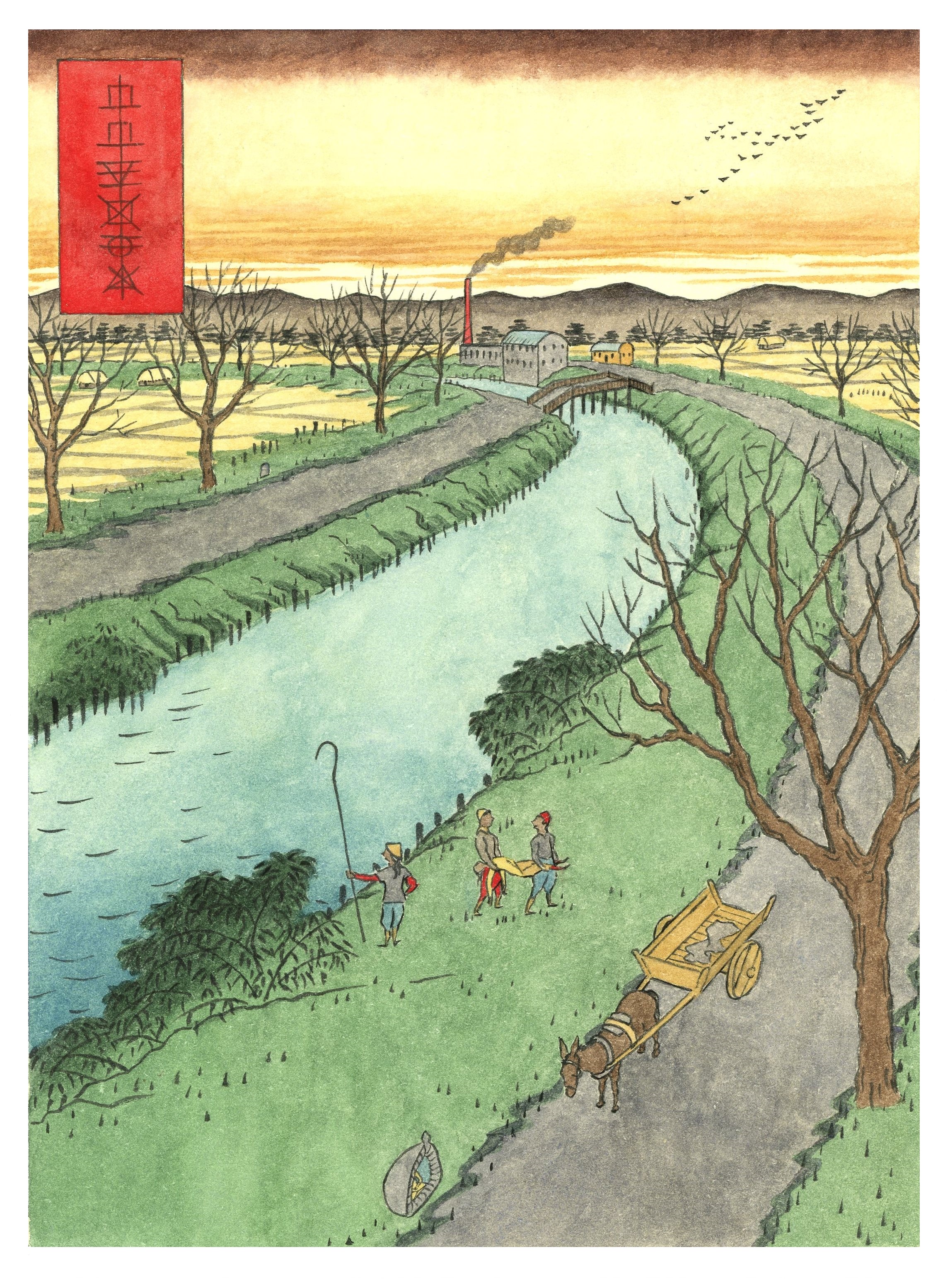
The Nachilagolu (“Long Canal”) connects the Juminta River just above Cherufi Falls to the imperial shipbuilding yards at Kulidaseh. After descending a number of locks near the falls, the canal runs for the rest of its course through a flat area still mainly devoted to rice farming, though a few industries, particularly garment factories and tanneries, have grown up along its banks. The print presents us with a view of the canal in late autumn. Two workmen are carrying the body of a man that has just been fished out of the water with the use of the long, hooked pole being held by a third workman. The men are about to load the corpse onto the mule-drawn cart by the side of the road, after which it will be taken to be disposed of in the Great Krokuta Pit (see n. 13).
The figure of the dead man is hard to make out, and we are not given any indication as to how he ended up in the canal. We can presume from the casual attitude of the workmen, however, that he is considered to be a person of no account. It seems likely that the artist intends us to view this death—either by murder, suicide, or an intoxicated stumble—as constituting the predictable conclusion of a difficult and painful life’s journey. At the same time, the very anonymity conferred upon the deceased by his small size serves as a reminder that his fate could potentially represent that of any number of the figures appearing in the other prints. All throughout the “Fifty-Two Views” series, the city’s inhabitants are, for the most part, depicted on a very small scale. It is easy to forget that each one of those tiny heads is carrying within it whole other unseen landscapes. Who can say what wild, tormenting waves are crashing down over those often almost antlike figures, or what lonely wastelands lie spread out before them in every direction, as far as the eye can see?
The wayside shrine in the foreground is dedicated to Todafon, the founder of Chogya, who preached the immortality of the soul through reincarnation. Its inclusion within the image can be read as a consolatory reminder that the soul of the unfortunate drowned man will be reborn anew within another life experience—hopefully, a far happier one.
Todafon taught that there is an eternal set of human lives. Although these lives exist in a chronological relation to one another, after death, individual souls may be reincarnated into lives taking place in periods that are antecedent, subsequent, or contemporary to their previous ones. Not only, then, is each soul destined to live on eternally in an endless succession of life experiences, but each life experience itself is destined to be endlessly relived by a succession of different souls. Even the very unhappy lives, such as this one that has just ended.
At this very moment, according to Chogya beliefs, another soul has commenced to live this same man’s life from the very beginning. The whole tragic concatenation of difficult early circumstances, disastrous key decisions, a truly epic unrequited love story, consistently and mercilessly ground-up hopes, and a stubborn inability to assimilate a certain crucial life lesson is destined to repeat itself again and again, for all eternity. If true, this is an appalling state of affairs, to be sure. But the vastness of human suffering is such that no belief system can ever offer a truly satisfactory justification for it. It may be counted as a point in favour of Chogya that it never even attempts to do so.
There is also an odd sort of nobility that this concept of endless recurrence seems to bestow upon even the most pitiful of existences. Their reiteration elevates them into something eternal and—potentially—to be shared by all humanity. For those unfortunate souls condemned to live through these sad lives, there is solace in knowing that others have come before and others will come after them. They are never truly alone in their private pain. All of this has been gone through already and will be gone through again. Others have understood—others will understand—exactly how it feels to feel this way.