Views of an Imaginary City V – Lisipéh Terraces

viewsofanimaginarycity5Lisipéh Terraces

The Lisipéh Terraces take their name from Lisipéh hill, a rocky outcropping that rises steeply out of the narrow river valley upon which the centre of Sensuka is built. A century ago, owing to its forbidding topography, the hill was still largely uninhabited. The area thus constituted an untamed wilderness in the middle of the city that was much in favour with clandestine couples –both of lovers and of duellists. It was the Empress Kadoka who, partly with an eye to curtailing these sorts of activities, ordered the hill transformed into a vast public park, conceived as a series of concentric terraces rising up the slopes of the hilltop. Continue reading

Posted in illustration, Imaginary City, painting | Tagged , , , , , | 1 Comment

Views of an Imaginary City IV – View of Rilito Harbour

viewsofanimaginarycity4View of Rilito Harbour

The Sensuka suburb of Rilito is built around a fine harbour that has long made it a centre of the local fishing industry. In the last decade, however, the neighbourhood has acquired an unexpected fashionableness, owing to the curious aristocratic pastime of capestadiven -play acting as fishermen and fishmongers- that was made popular at court by the Emperor’s head concubine, Biruégh. Nothing now amuses the imperial courtiers more than to head down to Rilito harbour for the day, where they don extravagant “South Seas fisher-folk” costumes and set out on a specially appointed “fisher-folk barge”, amply provisioned with fine food and drink –especially drink. A few fishermen from Rilito are brought along to do most of the actual fishing, although the lords and ladies will occasionally take turns dangling a fishing rod over the side of the boat.

It is only when the merry crew returns to shore, however, that the real fun begins. Continue reading

Posted in illustration, Imaginary City, painting | Tagged , , , , , , | 2 Comments

Views of an Imaginary City III – The Cloud Oracle at Marikora

viewsofanimaginarycity3The Cloud Oracle of Marikora

Rather than such messy and, when one comes to think of it, somewhat dubious sources of divination as are the reading of tea leaves and sheep entrails, in Sensuka the foretelling of future events is obtained through an altogether more pleasant and poetic method: the observation of cloud formations. This task is carried out by officially appointed priests, always of a very advanced age, who have spent their entire lives learning how to accurately interpret the prophecies contained within the tumbling masses of cumulonimbi, or in the subtle colour degradations in a streak of cirrostratus.

Although cloud divination can theoretically be carried out from any vantage point, Continue reading

Posted in illustration, Imaginary City, painting | Tagged , , | Leave a comment

Views of an Imaginary City II – View from Berino

viewsofanimaginarycity2View from Berino

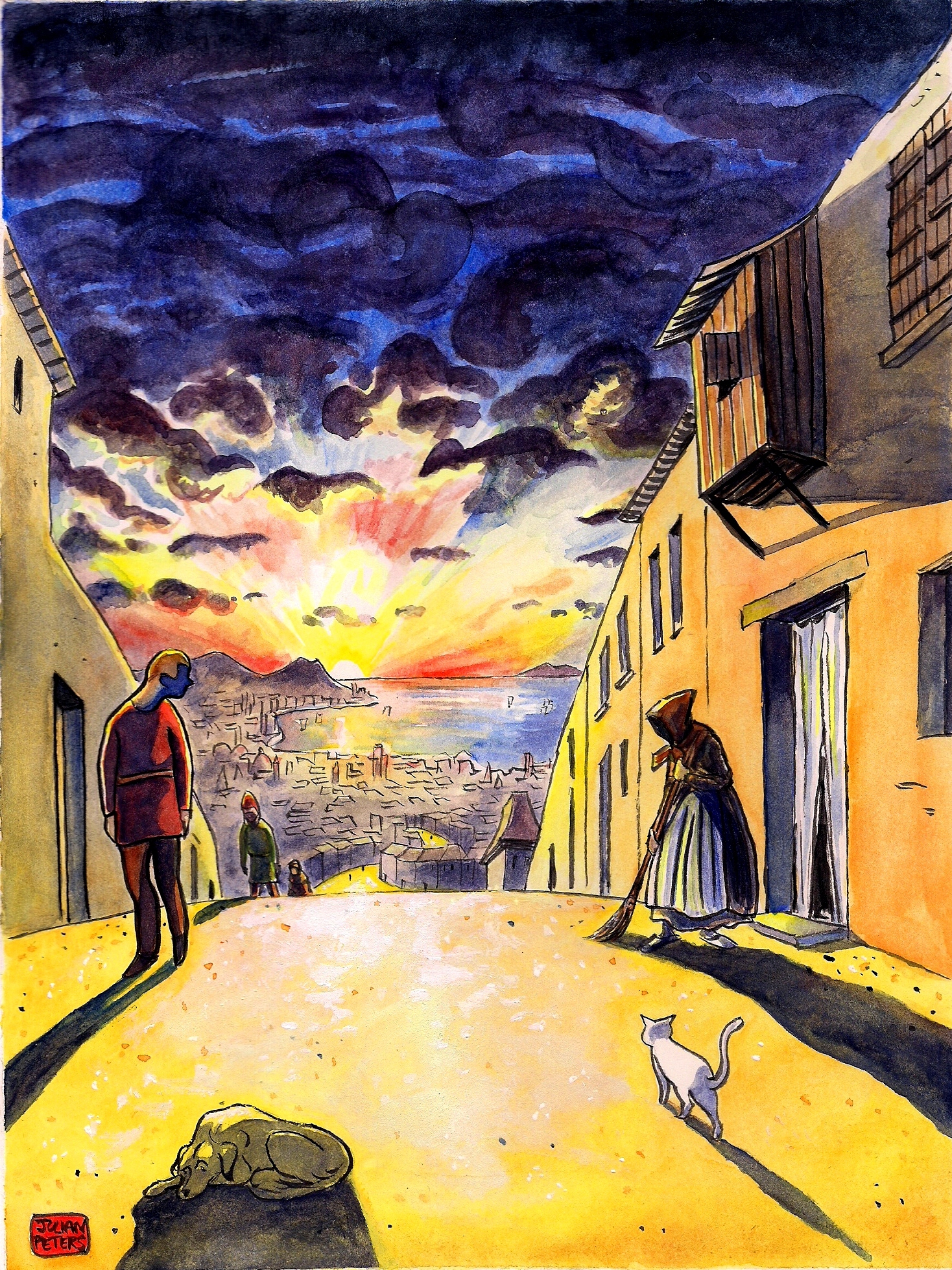
The inconspicuously named 23rd Avenue in the outlying neighbourhood of Berino is blessed with one of the most spectacular views in all of Sensuka. The street runs along the crest of the high hilltop upon which Berino is situated, and then snakes its way downwards in a progression of wide curves in the direction of the city centre. On clear evenings, the sun’s dying rays fall upon the paving stones in such a way that 23rd Avenue appears as a curling ribbon of burnished gold, drawing the eye  down towards the reddening tops of the city spires and the shimmering sea beyond.

Berino is not a wealthy neighbourhood, however, far from it, Continue reading

Posted in illustration, Imaginary City | Tagged , , | 2 Comments

Views of an Imaginary City I – The Two Main Squares

viewsofanimaginarycity1

The Two Main Squares

The previous imperial capital before Sensuka, Okrona, had been built around a grand central square. The square’s vast size made it a fitting setting for the celebration of imperial triumphs, and also provided sufficient space for the imperial dragoons to gather up speed when charging unruly mobs. For indeed, the major downside of having such a large open space in the heart of the downtown was that it provided a natural rallying point for the occasional popular uprisings that are an inevitable inconvenience of big-city living.

When laying out Sensuka, the Emperor Bulodi I wisely decided that, to avoid this problem in his new capital, the centre of the city should include not one main square, but two, Continue reading

Posted in illustration, Imaginary City | Tagged , , | 7 Comments

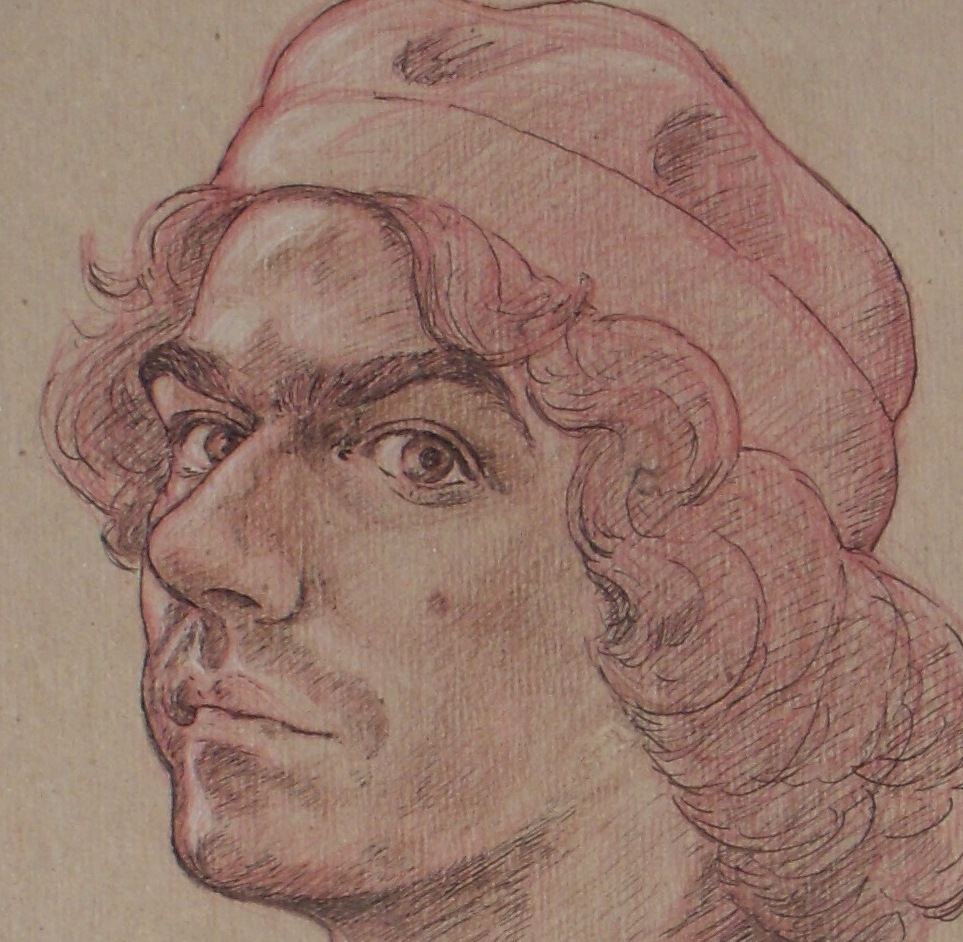
Self-Portrait, c. 1490

botticelliportrait

Posted in illustration, sketches | Tagged , | Leave a comment

Coming Soon! “Fifty-two Views of an Imaginary City”

imaginarycity823
This summer, mostly during the course of an artistic residency at the Maison Gai Saber in Leigné-sur-Usseau, France, I began work on a long series of watercolours depicting the sights of interest, neighbourhoods and inhabitants of an imaginary city called Sensuka. Inspired by Ando Hiroshige’s One Hundred Famous Views of Edo (1856-1859), as well as by Italo Calvino’s Invisible Cities (1972), my aim with these images and their accompanying explanatory paragraphs is to explore various emotions and ideas associated with cities and city life (as well as any other emotions or ideas that may be running about my head ). My plan is to create 52 imaginary views, and ideally to post one every week on this website for a year. Look for the first installment at the beginning of September. http://maisongaisaber.com/hello.html

Posted in illustration, Imaginary City | Tagged , , , , | 4 Comments

Arthur Rimbaud – Chanson de la plus haute tour – Song from the Highest Tower

chansondelaplushautetour3
I’m not altogether satisfied with this image (still finding my feet with watercolour), although I like the composition. There too, though, I’m annoyed by an inconsistency in the shadows: Why doesn’t Rimbaud’s body cast a shadow on the floor along with the shadow of the battlements?

The poem is perhaps my absolute favourite of Rimbaud’s. I won’t even bother trying to translate it, though; its beauty is all in its musicality, the way it seems to spiral gracefully into the ether like the smoke from one of Rimbaud’s clay pipe: Continue reading

Posted in Arthur Rimbaud, bande dessinée, comic book poetry, illustration, Poetry Comics | Tagged , | 1 Comment

“Annabel Lee” Video by Renée Latulippe and Interview

Annabel Lee videoThe immensely talented Renée Latulippe has created a video featuring her interpretation of Edgar Allan Poe’s “Annabel Lee” that incorporates the drawings in my comics adpatation of the poem. I was really impressed with the results, and it made me wish all my poetry comics could be given a similar treatment.

Click on the link below to view other “poetry videos” on Renée’s No Water River website, along with a whole slew of other resources aimed at presenting poetry to children: http://www.nowaterriver.com/

Also included with the video is an interview by Renée with yours truly, which I have copied below:

Julian, who are you, where are you, and how long have you been a doodling fool?

I am an illustrator, comic book artist, graduate student and language instructor living in Montreal, Canada. I have been drawing comics since before I could write. In my earliest stories, featuring Speeder the Struthiomimus (an ostrich-like dinosaur), I would dictate the dialogue to my dad, who would fill in the dialogue balloons I had left blank for him. Until the age of twelve I churned out all kinds of comics on the most disparate subjects, but then when I hit adolescence –and this is one of my great regrets- I gave up drawing comics entirely, and didn’t really begin again until I was in my early twenties. I can’t help wondering sometimes how much more advanced my comics-making skills would be now if I hadn’t had that “lost decade” to catch up on. Continue reading

Posted in Annabel Lee, comic book poetry, Edgar Allan Poe, Poetry Comics | Tagged , , , | 6 Comments

The Great Gatsby

scan0002

Click on image to enlarge

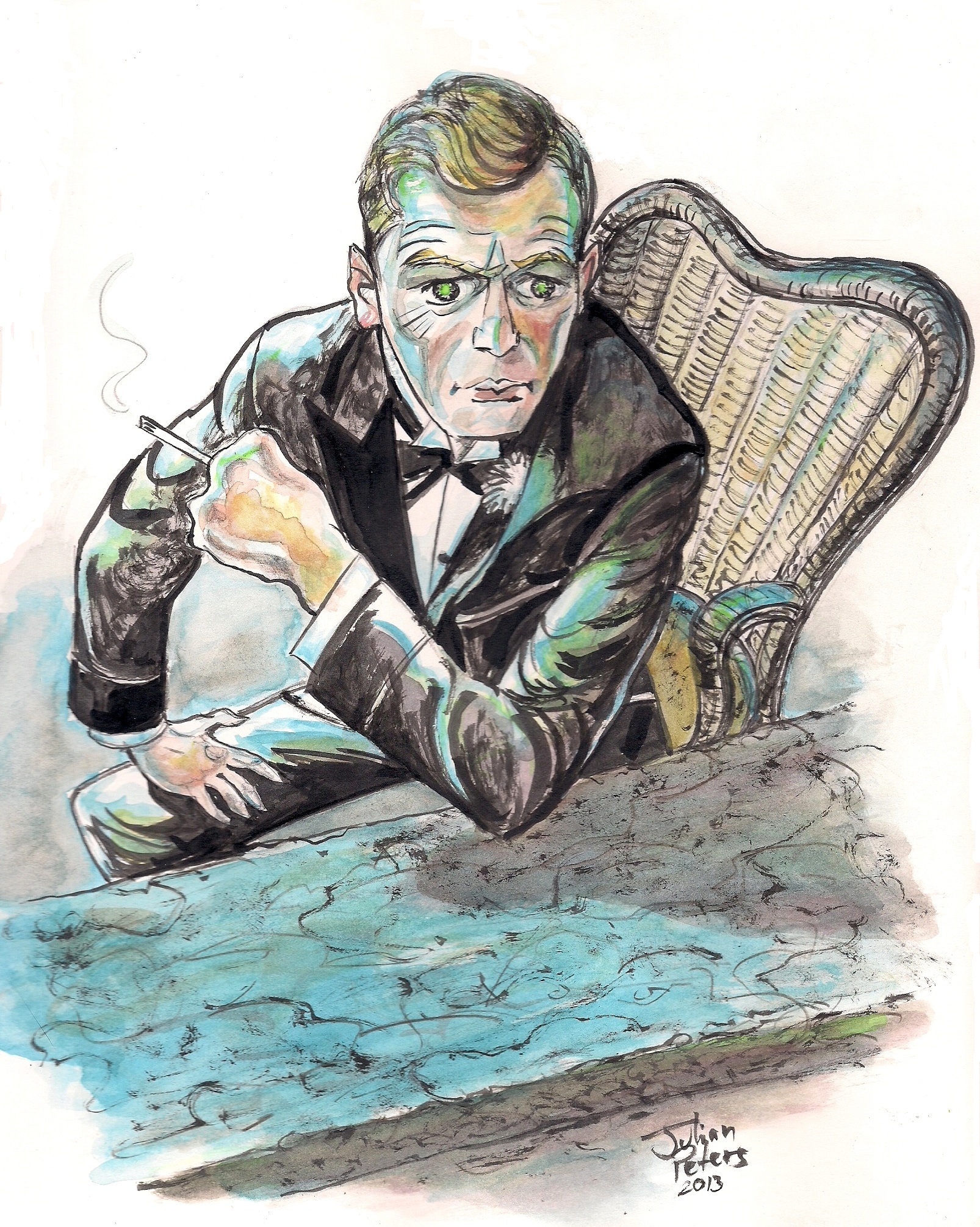
Prompted by the release of its umpteenth cinematic adaptation, I have just reread The Great Gatsby for the umpteenth time. I was particularly struck this time around by the degree to which the novel’s ultimate emotional payoff seems so much greater than what would appear to be warranted by the emotional entanglements of its caricaturish, at times almost cartoonish characters (Gatsby himself occasionally comes off a little like an older, hopeless-romantic version of Richie Rich). That Fitzgerald achieves this feat is due in large part to the novel’s magisterial, sweepingly poetic and universal last page. It is the closing lines of this last page to end all last pages that this drawing seeks in part to illustrate [spoiler alert!]:

“…I  thought of Gatsby’s wonder when he first picked out the green light at the end of Daisy’s dock. He had come a long way to this blue lawn, and his dream must have seemed so close that he could hardly fail to grasp it. He did not know that it was already behind him, somewhere back in that vast obscurity beyond the city, where the dark fields of the republic rolled on under the night.
Gatsby believed in the green light, the orgiastic future that year by year recedes before us. It eluded us then, but that’s no matter- tomorrow we will run faster, stretch out our arms farther… And one fine morning-
So we beat on, boats against the current, borne back ceaselessly into the past.”

Posted in illustration | Tagged , , , , , , , | 2 Comments